I'm telling you, I think there was a planet between Mars and Jupiter. Astronomers from the 1500s to the early 1800s believed the same.
So, between the sun and Mercury, you've got 0.4 AU. An AU, or astronomical unit, is the distance from the Earth to the sun, about 93 million miles.
Now, astronomers use AU as a yardstick for the solar system. So, Venus sits at 0.7. Earth, 1. Mars, about 1.5. Then there's a huge empty stretch before you hit Jupiter at 5.2. Johannes Kepler -- an astronomer -- noticed that gap back in 1596 and figured a planet had to be hiding in it.
In the 1760s, two German astronomers, Johann Titius and Johann Bode (I had to look 'em up, since names seem to fall out of my head constantly), found a simple number pattern that matched every planet's distance from the sun. And that same pattern said a planet should be sitting at 2.8 AU, right between Mars and Jupiter. When Uranus turned up in 1781 almost exactly where the pattern predicted, astronomers were convinced. Something belonged at 2.8. But it wasn't there. Or, it was, and they haven't found it.
What they eventually did find?
Ceres.
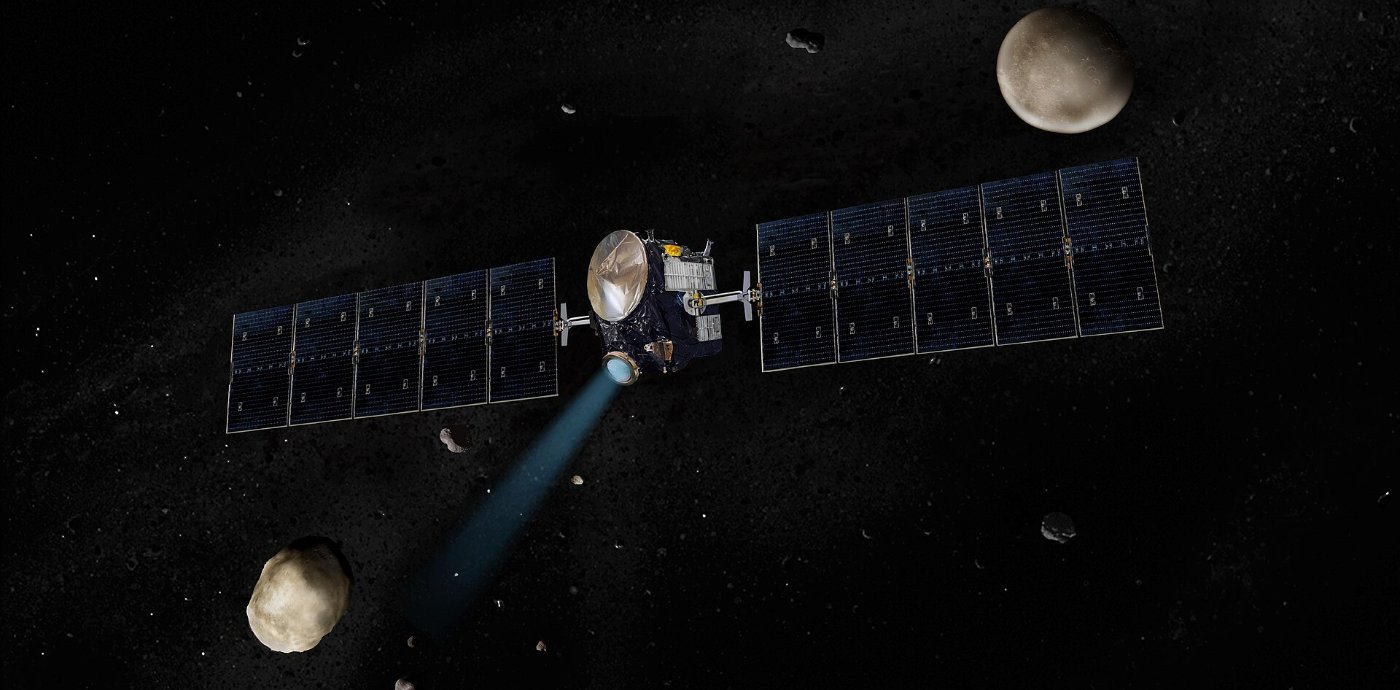
It sat almost exactly where that rule said it would, but it was too small. Then they found big, massive rocks, asteroids, some moon-sized, and some dwarf planets, so they posited these were remnants of a planet that was once there. And some asteroids are made of metal, iron and nickel, and those are found in the core of planets.
A guy named Heinrich Olbers, the guy who found the second asteroid in 1802 (and yes, had to look him up too, because couldn't remember his name), said these were pieces of a planet that broke apart.
So, let's look at this in a different angle, because to me, there had to be something there, and there wasn't always an asteroid belt between Mars and Jupiter. Scientists figure it once held a thousand times more material.
So where'd it go?
Jupiter.
Its gravity tugs on the belt over and over and rocks, big ones, get thrown out of orbit. Now, some fell toward the sun, some slammed into planets and moons, and here's something you didn't know, most of the meteorites that land on Earth come from out there, from that belt.
Mars got hit. Earth got hit. Venus. Mercury. Just about all the moons and planets.
In 2014, astronomers spotted a rock coming in from the far edge of the solar system, way past Neptune, that looked like it was created (born) in the inner solar system, and science said that something threw it out there a long time ago.
I'm telling you. Something big was there. Between Mars and Jupiter.
Now, how did this planet explode? Well, if you buy my next book... just kidding.
Okay, so, I have a lot of thoughts on this, some tied to Sumerian mythology, but I won't get into that. However, if we're talking science? You've got a planet colliding into a planet. One can reform, and one can shoot off in all directions. Planets can literally, and this is super rare, blow up from the inside, depending on how much uranium is in the actual core and crust. Jupiter could have been the cause, and in so many ways. Or, the most plausible one, two civilizations lived in that region, on Mars and on the planet between Mars and Jupiter. They got into a war. And with incredibly high tech, horrible weapons. Mars, like the death star, blew up said planet between Mars and Jupiter, using some type of energy harnessing weapon using its own energy to tear apart another enemy planet, and in the process, the explosion from this now missing planet, tore off Mars's atmosphere. The survivors left to Earth.
I mean, is there any other explanation? Wink. Wink.
Okay, putting my story, though cool, to the side, I do think there was a planet sitting right there, between Mars and Jupiter. And so did -- and so do -- many astronomers.
All I'm saying, there's some science behind the claim, and some very well-known scientists and astronomers thinking the same thing, that a planet that was once in our Solar System is no longer there.
Image: NASA/JPL, public domain, via Wikimedia Commons.