When I went to college, I had no idea what I wanted to be when I grew up. Well, not true. At first, I wanted to be a Christian minister. I carried my bible everywhere, and read it, everywhere. My major was "Religions" and after about a year, and after shadowing a few ministers, I changed my mind and became a Philosophy major. Two semesters of that, and my dad was asking, "Where you going to get work being a Philosophy major?"
So, I decided on History as my major. And for years, it stuck. Even with my dad saying, "Are you going to be a professor or something? That's the only job you can get with that degree, Bran."
Regardless, History was my favorite class. Didn't matter the history, I liked it all.
Yet... eventually, I decided to dedicate myself to helping people in a more productive way, especially after a Sports Massage Therapist helped an injury of mine that no other doctor or chiropractor could help. It inspired me to give back to others, so I found my way to Massage Therapy school, and became THAT Sports Massage Therapist's disciple, where I REALLY learned how to help people out of chronic and acute pain, alleviate their range of motion issues, and balance their nervous systems.
Because of legal issues and medical jargon and because allopathic medicine has a monopoly on verbiage, no massage therapist can say we 'fixed' anything, even if it's true and apparent.
But, I digress...
Regardless of me becoming a Sports Massage Therapist, History stuck with me for years, and I never let it go, and with my newsletter, you can probably tell. I research it on the daily, and I use it in my books best I can, whether it's mysteries inside of history that I've tried to decode or scientific factual consensus that I'm fascinated with, it's always in my life, one way, shape, or form.
And, last week, I was hired at my daughter's school to teach one day of History class a week. And it's a blast.
If you knew me, or really knew me, you'd know how silly I am. Especially with kids and teens. I'm not like that in a professional setting, or when you've first met me. You'd probably think I was a kind, peaceful person. And I am. But once you get to know me, I'm a bit... well... goofy. Yes, goofy looking, but personality-wise, goofy acting, too.
Now, when I say I was hired as the history teacher at my youngest daughter's school, it's not a paid position. Not for a parent. In truth, I'm filling in until they can get another teacher. But after my first class last week, and my second class this week, turns out, I'm their new favorite teacher.
Not to toot my own horn, but if you make learning fun, students show up for it.
When I teach, I bring mystery, over-the-top gestures, and storytelling to my class, with an added bonus of funny and silliness that makes it at least semi-fun. I think.
But I don't start with mainstream history.
Since the parents were saying I may be covering for the remainder of the year, I had to put together a slideshow of what I'd teach, the questions I'd ask the students, and the quizzes I'd bring. I did it website-style, meaning I prepared the slideshow, the videos, and the interactive web page on a free site. And since I started building websites more than twenty years ago and haven't stopped, I made a pretty solid presentation. Even the students were impressed with it.
That showed them I was serious. I was volunteering my time to educate them with new information. The most up-to-date research out there.
Most schools teach history written fifty or more years ago without much of an update at all. I learned that from my youngest daughter's history class last year. I helped her with homework, and I couldn't help rolling my eyes, correcting the information being presented to her.
So, what have I started with? The Younger Dryas. Class 1. Göbekli Tepe. Class 2. The students had never heard of any of it. And this is where most of our civilized history began, right after the Younger Dryas Boundary event, and the mystery and civilization of Gobekli Tepe. For those of you looking up Gobekli Tepe being categorized as a civilization rather than just a monument, and you're not finding that update, watch the new research through podcasts. That's where you'll get that information.
I won't even mention its sister site, which is much larger. And it's near Gobekli Tepe. There are other sites around it, too, that are very similar. You don't have hunter-gatherers making those kinds of sites. You have a society with agriculture. Mainstream archaeologists say that's impossible, even with these structures, and others, staring them right in the face.
So, we don't deal with mainstream history in my class. Yes, we'll go over it, but the focus will be on new research. Updated research.
Next class, we'll go over a dozen flood myths. There are over 500 flood myths from all over the world, and we'll pick some popular ones and discuss. How they're all related. How they're so similar, even though continents apart. How could they be so similar if these cultures never met? That means something happened. Then we'll tie it back to the first class, the Younger Dryas, and the second class, Gobekli Tepe. Because why was it purposely filled in? Covered up?
Good questions.
Here's a bit of what I'll be teaching them next week, along with Noah's Ark, and others...
Polynesian and Pacific Flood Myths
I wrote this above. Over 500 flood myths, from every corner of the planet. Cultures that never had contact with each other, telling the same story. The water came and the world drowned and few survived.
That alone should make anyone curious. That many flood myths can't be a coincidence. It's a mathematical impossibility.
But when you narrow it down to just the Pacific, the Polynesian and surrounding cultures, it gets even stranger. Because these people were separated by thousands of miles of open ocean. No roads or trade routes. Just water, and they all carried a version of the same memory. They're longer tales than I'll share, but you'll see the gist of it all.
Let's start with the Maori of New Zealand.
The Maori tell of a great flood called "The Overturning of Mataaho." In this story, a man named Puta preached to the wicked tribes in the name of the god Tane. Most ignored him. One man, Mataaho, was the most stubborn of all. Puta prayed to Rangi, the sky, to overturn the earth. The earth flipped. The waters swallowed everything. All the people perished in the deluge except those who survived on a raft. After the waters receded, the survivors offered seaweed to the gods because they had no other sacrifice. Then they looked up and saw Kahukura, the rainbow, standing in the sky. A sign. A covenant.
Now go 4,000 kilometers northeast, to Hawaii.
The Hawaiians tell of a man named Nu'u. A god named Kane warned him that a flood was coming. Nu'u built a great canoe with a house on it and filled it with animals. The waters rose and covered the entire earth. After the flood, Nu'u landed on the summit of Mauna Kea, the tallest peak in the Hawaiian Islands. He made a sacrifice, but he mistakenly offered it to the moon. Kane descended on a rainbow, corrected him, and forgave him. That rainbow, again.
There's also an older Hawaiian account, one that predates any missionary contact. Old Hawaiians told early European visitors that all the land had been overflowed by the sea, and that only the peak of Mauna Kea remained above the waterline, where two people were saved. They called it the Kai-a-Kahinali'i. They had never heard of Noah and they had never heard of an ark. They already had their own story.
Go south. Way south. To Australia.
Aboriginal Australians carry flood stories that researchers now believe date back over 10,000 years through oral tradition. One account from the Wunambal people of Western Australia tells of a man named Gajara. In those ancient days, children tormented an owl, plucking its feathers and mocking it. The owl flew to Ngowungu, the Great Father. Ngowungu became angry and decided to drown the people. A small cloud appeared and grew until it covered the sky. Thunder rolled. A terrible wind snapped trees and tore them from the earth. The sea rushed inland. Only Gajara and his family, who had built a raft and tied it to a tree, survived. After the waters receded, Gajara sent birds out to see if the land had dried. When they didn't return, he knew it was safe.
Now go east again, all the way to Rapa Nui. Easter Island.
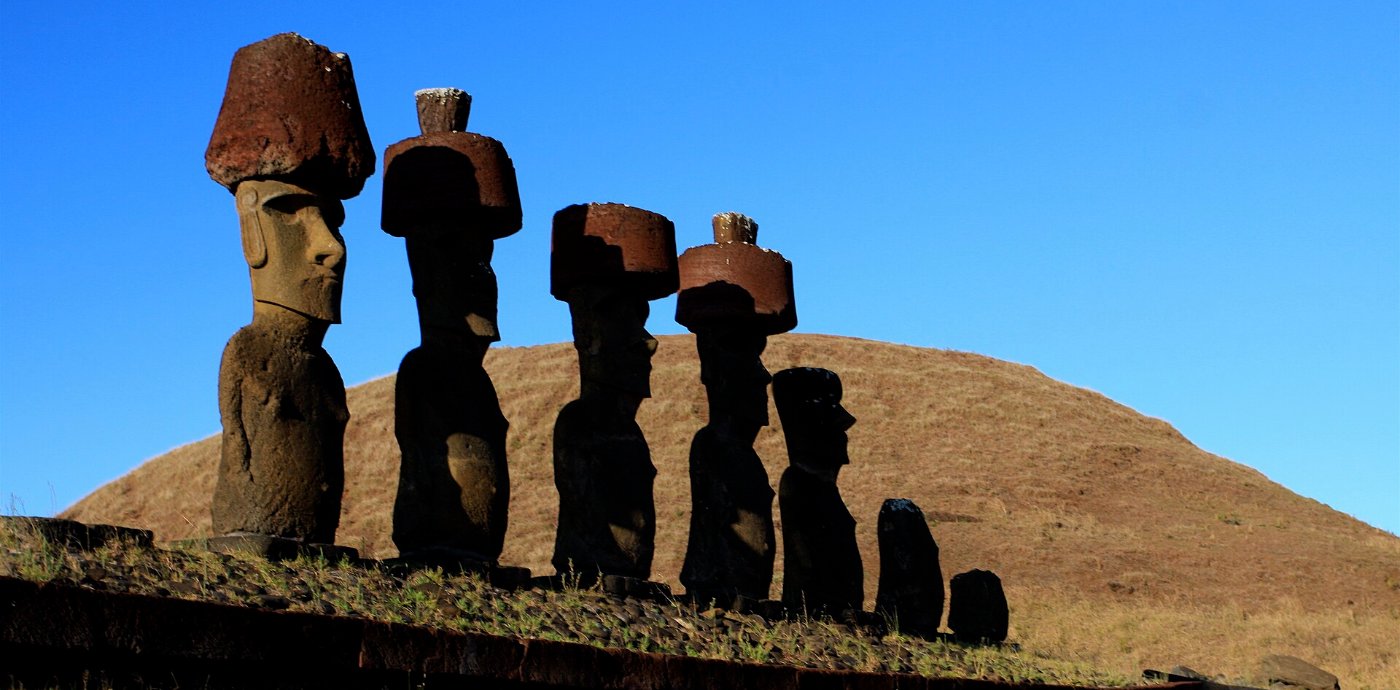
The Rapanui tell of a homeland called Hiva. A priest named Haumaka had a prophetic dream: Hiva was going to sink beneath the ocean. Their king, Hotu Matu'a, sent seven explorers eastward across the open Pacific to find new land. They found a small island. Later, Hotu Matu'a loaded two great canoes with his people, over a hundred of them, and sailed east. They landed at Anakena beach and called the island Te Pito o Te Henua. "The Navel of the World."
Their story is about a flood along with a sinking land. A catastrophe that forced an entire civilization to relocate across the largest ocean on the planet. The Rapanui say the rain came and that their home went under the sea.
And Tahiti. On the island of Raiatea, the story goes that a fisherman paddled out over a coral reef and dropped his hooks into the water. The hooks tangled in the hair of Ruahatu, a sea god sleeping on the ocean floor. Ruahatu rose to the surface, furious, and threatened to destroy the land. The fisherman begged for mercy. Ruahatu told him to take his wife and child to a tiny islet within the reef, Toamarama, and they would be safe. The sea rose. Everything around them went under. Only that family survived.
What's interesting about the Tahitian versions is that the flood is always described as the sea rising, not rain falling. Early missionaries who recorded these stories noted that the Tahitians had no concept of rain causing a flood. It was always the ocean. Always from below.
So here's what you're looking at.
New Zealand. Hawaii. Australia. Easter Island. Tahiti. Separated by thousands and thousands of miles of open ocean. Most of these cultures had no knowledge of each other. And they all carried a version of the same event. A warning, a flood, a small number of survivors, and a covenant or sign from the divine, often a rainbow. A vessel. A new beginning.
You don't get that from coincidence. You don't get 500 versions of the same story from imagination. You get it from something that happened, something so catastrophic that every surviving culture on the planet teaching the memory forward, generation after generation, for thousands of years.
That's what we're covering in class three. And now you got to sit in on it, too.
Photo: TravelingOtter, CC BY 2.0, via Wikimedia Commons.